

Golf improvement depends on repetition, consistency, and the ability to understand what is happening in your swing.
But weather, daylight, busy schedules, and seasonal conditions can make regular practice difficult.
That is one reason indoor golf simulators have become such a valuable training option for golfers of different skill levels.
A golf simulator allows you to practice your swing in a controlled indoor environment while receiving immediate information about each shot.
Instead of waiting for perfect weather or relying only on outdoor practice, you can continue working on your game throughout the year.
Here are some of the biggest ways indoor golf simulator practice can help you become a more consistent and confident golfer.
1. You Can Practice Golf Year-Round
One of the most obvious benefits of an indoor golf simulator is consistency.
Outdoor golf practice is often affected by:
- Rain
- Cold temperatures
- Snow
- Extreme heat
- Limited daylight
- Seasonal course availability
These interruptions can make it difficult to maintain your swing throughout the year.
Indoor golf removes many of those limitations.
You can continue practicing even when outdoor conditions are not ideal.
For golfers in New York, this can be especially valuable during colder months when regular outdoor practice becomes much more difficult.
Keeping your swing active throughout the year can help reduce the feeling of having to “start over” every spring.
2. You Receive Immediate Feedback After Every Shot
When hitting balls at a traditional driving range, you can see where the ball travels—but you may not always understand why it traveled that way.
Golf simulator technology can provide additional information about each shot.
Depending on the simulator system, this may include measurements related to:
- Ball speed
- Launch angle
- Carry distance
- Total distance
- Club path
- Spin
- Shot direction
- Club speed
This data gives you another way to evaluate your swing.
Instead of simply thinking, “That shot felt good,” you can begin identifying patterns in your performance.
The goal is not to obsess over every number.
The value comes from using feedback to better understand what is consistently happening in your swing.
3. You Can Practice With More Purpose
Many golfers go to the driving range and hit ball after ball without a specific plan.
While repetition can be useful, random repetition does not always lead to improvement.
A golf simulator makes it easier to structure your practice.
For example, you could spend a session focusing on:
- Distance control
- Driver consistency
- Iron accuracy
- Wedge shots
- Shot shape
- Tempo
- Club selection
Instead of hitting dozens of balls without direction, you can create specific goals for each practice session.
Purposeful practice often makes it easier to notice improvement over time.
4. You Can Better Understand Your Distances
Knowing how far you actually hit each club is extremely important on the course.
Many golfers estimate their distances based on their best shots rather than their typical shots.
That can lead to poor club selection.
Golf simulator practice gives you an opportunity to hit multiple shots with the same club and compare the results.
Over time, you can develop a clearer understanding of your average distances.
For example, you may discover that your typical 7-iron carry is different from what you assumed.
That information can help you make more confident decisions when playing outdoors.
Good course management starts with realistic expectations.
5. It Helps You Identify Patterns in Your Swing
Golf improvement often comes from recognizing patterns.
Maybe your drives consistently move to one side.
Maybe your short irons are accurate but your longer clubs become inconsistent.
Maybe your distance changes dramatically when your swing tempo becomes too fast.
A simulator makes these patterns easier to observe.
Instead of evaluating a single shot, you can look at a series of shots.
This helps answer more useful questions:
- What happens when I miss?
- Is my miss consistently in one direction?
- Which clubs are the most reliable?
- Where am I losing distance?
- Which parts of my game need more practice?
Understanding your tendencies can make practice much more productive.
6. You Can Work on Specific Clubs
You do not need to practice your entire golf bag during every session.
Sometimes the fastest way to improve is to focus on one area.
An indoor simulator gives you the flexibility to dedicate a session to a particular club or group of clubs.
For example:
Driver Practice
Work on launch, direction, consistency, and distance.
Iron Practice
Focus on accuracy, contact, and reliable carry distances.
Wedge Practice
Practice distance control at different yardages.
Club Comparison
Compare how different clubs perform and better understand where each belongs in your game.
This targeted approach can be much more useful than simply hitting clubs in random order.
7. You Can Practice Without Feeling Rushed
A busy golf course or driving range can sometimes make practice feel rushed.
You may feel pressure from people waiting behind you or become distracted by what is happening around you.
Indoor golf creates a more controlled training environment.
You can slow down, reset between shots, analyze what happened, and focus on your next swing.
That extra attention can help improve the quality of your practice.
Golf requires concentration.
Having an environment where you can focus on the process—not just the result—can make a significant difference.
8. Golf Simulators Can Make Practice More Engaging
Practice does not always need to feel repetitive.
Golf simulators can make training more interactive by allowing golfers to experience different courses, distances, targets, and challenges.
This can make practice more enjoyable while still developing useful skills.
Instead of only hitting balls toward the same range target, you can practice situations that feel closer to real golf.
For many players, this added variety makes it easier to practice more consistently.
And consistency is one of the most important factors in improving any skill.
9. Beginners Can Learn in a Comfortable Environment
Golf can feel intimidating when you are just getting started.
A traditional course comes with rules, pace expectations, other players, and many unfamiliar situations.
An indoor simulator can provide a more relaxed place to begin learning.
Beginners can focus on:
- Basic setup
- Grip
- Swing movement
- Making consistent contact
- Understanding different clubs
- Learning distance control
There is less pressure to keep up with an entire course.
This allows new golfers to develop confidence before taking their game outdoors.
10. Experienced Golfers Can Use It for More Detailed Practice
Golf simulators are not only for beginners.
More experienced golfers can also benefit from detailed practice.
When your basic swing is already established, small improvements become increasingly important.
Data and repeated practice can help experienced players evaluate changes more carefully.
For example, a golfer experimenting with a swing adjustment can compare multiple shots before and after the change.
This creates a more objective way to evaluate whether an adjustment is actually improving performance.
Golf Simulator Practice vs. the Driving Range
Both can play an important role in golf training.
A driving range provides the experience of seeing your actual ball flight outdoors and adapting to real environmental conditions.
A golf simulator offers a controlled environment, detailed feedback, and year-round accessibility.
They do not necessarily need to replace one another.
For many golfers, combining indoor simulator practice with outdoor range sessions and course play can create a more complete approach to improvement.
Indoor training can help you work on specific elements of your game, while outdoor golf helps you apply those skills in real conditions.
How Often Should You Practice Golf?
There is no perfect practice schedule for everyone.
The right frequency depends on your goals, experience, and available time.
However, shorter and more consistent practice sessions can often be more valuable than one very long session every few weeks.
If you only have limited time, even a focused simulator session can give you an opportunity to work on one part of your game.
Quality matters more than simply hitting as many balls as possible.
Before each session, decide what you want to improve.
That small step can make your practice much more productive.
Indoor Golf at FORZA Gym in Mount Kisco
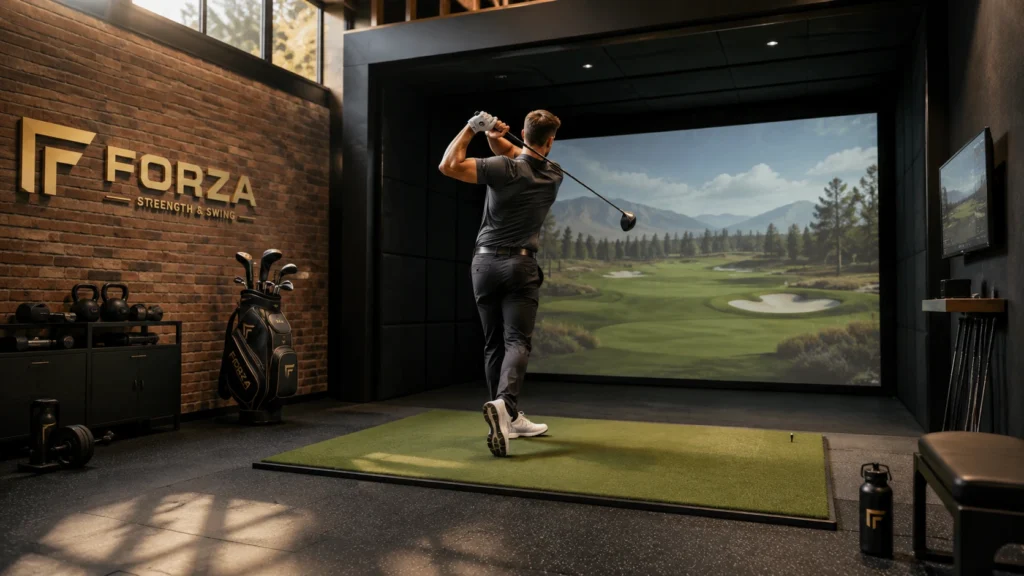
At FORZA Gym in Mount Kisco, the Golf Simulator provides golfers with a dedicated indoor environment to practice, play, and work on their game throughout the year.
Whether you want to maintain your swing during the colder months, understand your distances better, work on specific clubs, or simply enjoy more golf without depending on outdoor conditions, indoor practice can help you stay connected to the game.
The goal is not just to hit more golf balls.
It is to make every practice session more intentional.
Frequently Asked Questions
Can beginners use a golf simulator?
Yes.
Golf simulators can be a comfortable option for beginners because they allow you to practice in a controlled environment without the pressure of playing a full course.
Can a golf simulator help improve my swing?
A simulator can provide feedback about your shots and help you identify patterns. Combining that information with consistent practice and proper coaching can make your training more focused.
Is indoor golf useful during winter?
Yes.
One of the biggest advantages of indoor golf is being able to continue practicing during cold, rainy, or snowy conditions when outdoor golf may be difficult.
Can I practice specific clubs on a golf simulator?
Yes.
You can dedicate a session to your driver, irons, wedges, or other areas of your game.
Does a golf simulator replace playing on a real golf course?
Not completely.
Indoor practice and outdoor golf provide different benefits. Simulator practice can help develop consistency and understanding, while outdoor play helps you adapt to real course conditions, lies, weather, and decision-making.
Keep Your Golf Game Moving All Year
Golf improvement does not have to stop when the outdoor season slows down.
With consistent indoor practice, you can continue working on your swing, distances, accuracy, and confidence throughout the year.
Whether you are preparing for the next golf season or simply want more opportunities to play, the Golf Simulator at FORZA Gym in Mount Kisco gives you a dedicated place to keep practicing.
Explore the Golf Simulator at FORZA Gym and keep your swing in motion year-round.