

Is Fitness Kickboxing a Good Full-Body Workout?
If you are looking for a workout that combines cardio, strength, coordination, and energy in one session, fitness kickboxing can be a powerful option.
Unlike traditional cardio workouts that may focus mainly on running, cycling, or repetitive machine-based movement, kickboxing challenges your entire body through punches, kicks, footwork, defensive movement, and conditioning exercises.
But is fitness kickboxing really a full-body workout?
The short answer is yes.
A well-structured kickboxing workout can engage your upper body, lower body, core, cardiovascular system, balance, coordination, and endurance—all within the same session.
Here is why.
1. Kickboxing Engages Your Upper Body
Punching may look like an arm movement, but effective punches involve much more than the shoulders and hands.
When you throw a jab, cross, hook, or uppercut, your body works together to create the movement.
Your:
- Shoulders
- Chest
- Upper back
- Arms
- Core
all contribute to generating and controlling each punch.
Repeated combinations can challenge muscular endurance while improving coordination between the upper and lower body.
Over time, this can help you become more efficient and controlled in your movements.
2. Your Legs Work Throughout the Entire Session
Kickboxing places significant demand on the lower body.
Even when you are not throwing a kick, your legs are working to maintain stance, shift weight, move around the training area, and create power.
Common kickboxing movements may involve:
- Squatting
- Pivoting
- Lunging
- Stepping
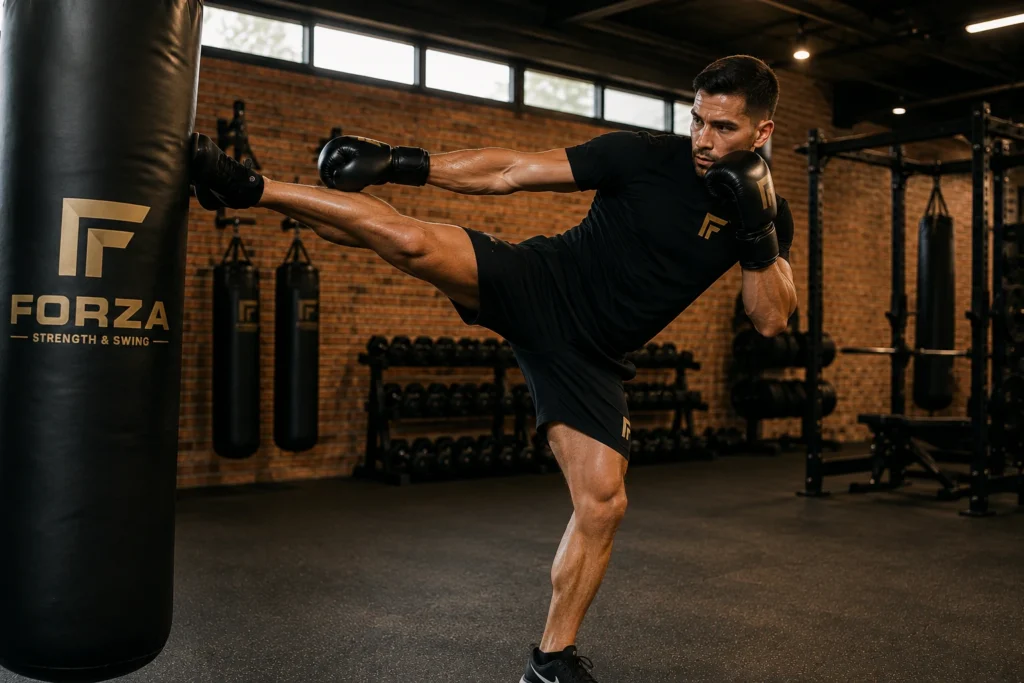
- Kicking
- Changing direction
Kicks also require strength and control from the hips, glutes, hamstrings, quadriceps, and calves.
The result is a workout that keeps the lower body active from beginning to end.
3. Your Core Connects Every Movement
Your core plays an important role in almost every kickboxing movement.
Punching and kicking require rotation, balance, and control.
Instead of simply moving your arms or legs independently, your torso helps transfer force through the body.
This means muscles around your:
- Abdominals
- Obliques
- Lower back
- Hips
are constantly working to stabilize and control movement.
A stronger, more coordinated core can also support better balance and posture both inside and outside the gym.
4. Kickboxing Can Be an Effective Cardio Workout
Fitness kickboxing can quickly raise your heart rate.
Punch combinations, footwork, kicks, and conditioning intervals often happen continuously or in timed rounds.
This creates a cardiovascular challenge while keeping the workout varied.
Rather than spending an entire session repeating one movement, you may alternate between:
- Punch combinations
- Kicks
- Footwork drills
- Bodyweight exercises
- Conditioning intervals
- Active recovery
This variety can make cardio feel more engaging for people who do not enjoy traditional cardio machines.
5. It Develops Coordination and Agility
Fitness is not only about strength and endurance.
Being able to control your body efficiently is also important.
Kickboxing challenges you to coordinate different movements at the same time.
For example, you may need to:
- Maintain your stance
- Move your feet
- Rotate your hips
- Throw a combination
- Return to your starting position
- Prepare for the next movement
At first, combinations may require concentration.
As your coordination improves, movements begin to feel more natural and fluid.
This can also improve body awareness and reaction speed.
6. It Can Improve Balance and Stability
Throwing a kick means temporarily balancing on one leg.
Rotating for punches requires maintaining control while shifting your body weight.
Footwork involves moving quickly without losing your stance.
All of these movements challenge balance and stability.
The goal is not simply to move faster.
It is to remain controlled while moving.
That combination of strength and control can be valuable for overall athletic ability.
7. Kickboxing Can Build Muscular Endurance
Fitness kickboxing is not the same as traditional heavy strength training, but it can still challenge muscular endurance.
Performing repeated punches, kicks, defensive movements, and conditioning exercises requires your muscles to keep working over time.
During a longer round, you may notice your shoulders, legs, and core becoming fatigued.
Learning to maintain technique while tired is part of the conditioning challenge.
This is one reason kickboxing can feel different from steady-state cardio.
Your muscles and cardiovascular system are working together.
8. It Keeps Workouts Mentally Engaging
One reason people stop following fitness routines is boredom.
Repeating the same workout every week can make training feel like another task on the schedule.
Kickboxing introduces a skill component.
You are not only exercising—you are learning combinations, improving technique, developing rhythm, and becoming more comfortable with different movements.
There is always something to improve.
For many people, this makes the workout feel more engaging and gives them another reason to keep coming back.
Fitness Kickboxing vs. Traditional Boxing
Fitness kickboxing and boxing share some similarities, but they are not exactly the same.
Boxing primarily focuses on punches, footwork, and defensive movements.
Kickboxing adds different types of kicks and additional lower-body movements.
That means kickboxing can involve an even broader range of full-body movement.
For fitness-focused participants, the goal does not need to be competition or fighting.
The workout can be structured around:
- Conditioning
- Technique
- Coordination
- Strength
- Endurance
- Overall fitness
You can benefit from kickboxing training without ever stepping into a competitive ring.
Is Kickboxing Good for Beginners?
Yes.
Beginners can participate in fitness kickboxing when the workout is appropriately structured.
You do not need previous martial arts experience to start.
A beginner may initially focus on:
- Basic stance
- Simple punches
- Fundamental kicks
- Footwork
- Controlled combinations
As technique and confidence improve, combinations can gradually become more challenging.
The goal is progression—not perfection on the first day.
How Many Calories Does Kickboxing Burn?
The number of calories burned during any workout varies significantly from person to person.
Factors include body size, fitness level, workout intensity, duration, and the structure of the session.
Because kickboxing involves continuous full-body movement, it can create a significant cardiovascular demand.
However, calorie burn should not be the only way to judge whether a workout is effective.
Improvements in strength, endurance, coordination, technique, and consistency are also important markers of progress.
Who Can Benefit From Fitness Kickboxing?
Fitness kickboxing may be a good choice if you:
- Want a high-energy workout
- Want to improve cardiovascular fitness
- Prefer workouts with variety
- Want to improve coordination and agility
- Want to challenge your entire body
- Find traditional cardio boring
- Want to learn a new physical skill
- Enjoy structured, fast-paced training
You do not need to consider yourself an athlete before starting.
The workout can be adapted as your fitness and technique improve.
Fitness Kickboxing at FORZA Gym in Mount Kisco
At FORZA Gym in Mount Kisco, kickboxing is designed to combine movement, conditioning, technique, and full-body training in an energetic environment.
Sessions help participants work on punches, kicks, coordination, footwork, and cardiovascular fitness while progressing at an appropriate level.
Whether you are looking for a challenging workout, a new way to improve your conditioning, or simply something more engaging than traditional cardio, kickboxing can add variety and purpose to your fitness routine.
Frequently Asked Questions
Is kickboxing good for weight loss?
Kickboxing can contribute to an active lifestyle and increase overall energy expenditure. Weight management, however, also depends on nutrition, activity levels, sleep, and other lifestyle factors.
Do I need boxing experience before starting?
No. Beginners can start by learning fundamental movements, stance, punches, kicks, and basic combinations.
Does kickboxing build muscle?
Kickboxing primarily develops cardiovascular fitness, coordination, and muscular endurance. It can strengthen many muscle groups, although traditional resistance training remains important when maximizing strength or muscle development is the primary goal.
Is kickboxing considered cardio or strength training?
It can include elements of both.
Kickboxing often provides a strong cardiovascular challenge while also requiring the legs, core, shoulders, and upper body to work repeatedly throughout the session.
How often should beginners do kickboxing?
Frequency depends on your current fitness level, recovery, and overall training schedule. Starting with one or two sessions per week can allow beginners to learn technique while gradually adapting to the workout.
Ready for a Different Kind of Workout?
Your cardio routine does not have to feel repetitive.
Fitness kickboxing combines strength, speed, endurance, coordination, and full-body movement into one energetic training experience.
Discover kickboxing at FORZA Gym in Mount Kisco and experience a workout that challenges more than just your cardiovascular fitness.
Explore Kickboxing at FORZA Gym.